
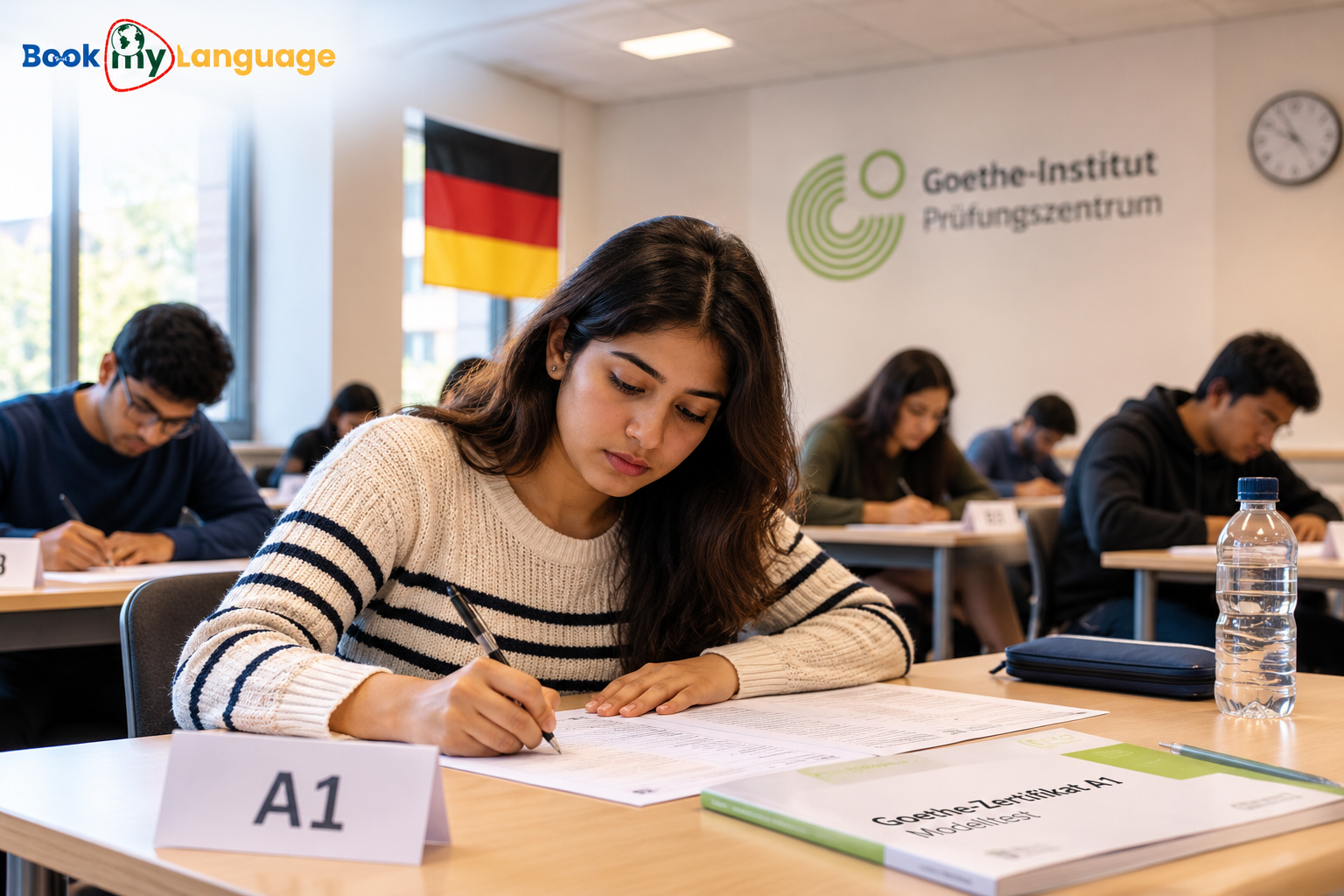
 German A1 Exam Preparation: A Complete Study Guide
If you are preparing for the German A1 Exam for the first time, it is normal to have questions about the exam pattern, preparation time, grammar, vocabulary, listening, writing and speaking requirements. This German A1 Exam Preparation guide is designed to help you understand what to expect and how to prepare in a structured way.
The German A1 Exam is the first formal step for many learners who want to demonstrate beginner-level German proficiency. The aim is not to speak perfect German. At A1, you need to show that you can understand and communicate simple information in familiar everyday situations.
This guide covers the exam structure, skill-wise preparation, study planning, common mistakes, official practice resources and practical exam-day advice.
What Is the German A1 Exam?
The German A1 Exam is a beginner-level German proficiency examination aligned with the A1 level of the Common European Framework of Reference for Languages (CEFR).
For learners taking the Goethe-Zertifikat A1: Start Deutsch 1, the examination checks whether they can understand and use familiar everyday expressions, introduce themselves, ask and answer simple personal questions and communicate at a basic level.
People take the German A1 Exam for different reasons. Some want to measure their progress before moving to A2. Others may need German-language proof for personal, professional, immigration or other official purposes.
Requirements vary depending on the university, employer, embassy, government authority or other organisation involved. Learners should always confirm the latest official requirement before registering for an examination.
German A1 Exam Structure
Understanding the German A1 Exam format before beginning serious preparation can reduce stress and help you practise more effectively.
The Goethe-Zertifikat A1: Start Deutsch 1 evaluates four core language skills:
| Section | What You Do | Approx. Duration |
|---|---|---|
| Hören – Listening | Listen to short everyday conversations, messages and announcements and answer related questions. | 20 minutes |
| Lesen – Reading | Read short notices, advertisements, signs, messages and other everyday texts. | 25 minutes |
| Schreiben – Writing | Complete basic information and write a short text connected to an everyday situation. | 20 minutes |
| Sprechen – Speaking | Introduce yourself, ask and answer simple questions and make basic requests. | 15 minutes |
The German A1 Exam becomes much easier to approach when you already understand what each section expects from you.
What Is the Passing Score for the German A1 Exam?
For the Goethe-Zertifikat A1: Start Deutsch 1, the examination is scored out of 100 points.
You need at least 60 points, or 60%, to pass.
During your German A1 Exam Preparation, avoid concentrating only on the skill you enjoy most. Listening, reading, writing and speaking all deserve regular attention.
Who Can Take the German A1 Exam?
The Goethe-Zertifikat A1: Start Deutsch 1 is primarily designed for adult learners. Goethe recommends an age of approximately 16 years or above for this examination.
The recommended age should not be confused with a universal eligibility restriction. Candidates should check the current examination conditions of the centre where they plan to register.
Before attempting the German A1 Exam, you should already have German knowledge corresponding approximately to CEFR A1.
Younger learners may have other Goethe examination options designed for their age group.
How Much German Do You Need Before the A1 Exam?
A common misunderstanding is that German A1 Exam Preparation means memorising a few sample answers shortly before the test.
Exam preparation is most effective when the learner already has a genuine A1 foundation.
Depending on previous language experience, learning environment and individual progress, the time required to reach A1 can vary considerably.
Some learners progress quickly, while others require more repetition in grammar, vocabulary, listening or speaking. There is no single study duration that works for everybody.
How to Prepare for the German A1 Exam
Effective German A1 Exam Preparation should combine language development with familiarity with the exam format.
A useful preparation plan includes:
- Everyday vocabulary
- Essential A1 grammar
- Listening practice
- Reading practice
- Short writing tasks
- Speaking practice
- Official model tests
- Review of mistakes
The German A1 Exam tests practical beginner German, so studying only grammar rules is not enough.
Build Strong A1 Vocabulary
Vocabulary forms the foundation of your German A1 Exam Preparation.
Important beginner topics include:
- Personal information
- Family
- Countries and nationalities
- Numbers
- Dates and days
- Time
- Food and drinks
- Shopping
- Home and accommodation
- Work and occupations
- Travel and transport
- Appointments
- Health
- Daily routine
- Hobbies and free time
Do not learn vocabulary only as isolated words.
For example, instead of memorising only:
Termin
practise it in a simple sentence:
Ich habe morgen einen Termin.
Learning words in context makes them easier to remember and use during the German A1 Exam.
Revise Essential A1 Grammar
You do not need advanced German grammar at A1, but your basic grammar should be reliable.
Important topics include:
- Personal pronouns
- Present-tense verb conjugation
- Common irregular verbs
- Definite and indefinite articles
- Nominative structures
- Basic accusative structures
- Question words
- Yes/no questions
- Basic modal verbs
- Negation using nicht and kein
- Possessive articles
- Basic German word order
- Numbers, dates and time
- Common beginner-level prepositions
Your goal during German A1 Exam Preparation should be to produce simple, correct German rather than unnecessarily complicated sentences.
German A1 Exam Listening Preparation
The listening section can initially feel difficult because spoken German sounds faster than the German learners see in textbooks.
During German A1 Exam listening practice, do not try to understand every single word.
Train yourself to identify important information such as:
- Names
- Numbers
- Telephone numbers
- Times
- Dates
- Prices
- Locations
- Appointments
- Simple instructions
Ask yourself:
- Who is speaking?
- Where are they?
- What does the person want?
- What time or day is mentioned?
- What information is actually required to answer the question?
Short daily listening practice is generally more useful than doing several hours of listening only once a week.
German A1 Exam Reading Preparation
The reading section of the German A1 Exam focuses on short, practical everyday texts.
You may practise with:
- Short emails
- Messages
- Advertisements
- Signs
- Notices
- Opening hours
- Short announcements
- Simple public information
Do not translate every sentence word for word.
First identify what the text is about. Then search for the specific information required by the question.
Pay particular attention to names, dates, times, prices and places.
German A1 Exam Writing Preparation
The writing section of the German A1 Exam does not require advanced vocabulary or long essays.
Practise producing short, clear sentences that communicate the required information.
Useful writing practice includes:
- Completing simple personal information
- Writing a short invitation
- Accepting an invitation
- Declining an invitation
- Requesting information
- Writing a short apology
- Providing simple information about yourself
- Using appropriate greetings and closing expressions
After completing a writing task, check:
- Did I answer every requested point?
- Is my verb correctly conjugated?
- Is the word order understandable?
- Did I spell important words correctly?
- Did I write German nouns with capital letters?
Simple and accurate German is often better than trying to impress with complex sentences.
German A1 Exam Speaking Preparation
Speaking is one of the areas where regular practice makes the biggest difference.
During your German A1 Exam Preparation, practise introducing yourself naturally.
Become comfortable talking about:
- Your name
- Your age
- Your country
- Your city
- Your occupation
- Your languages
- Your family
- Your hobbies
You should also practise asking basic questions, responding to simple questions and making everyday requests.
Do not memorise one long speech.
If the question changes slightly, memorised answers can become difficult to adapt. Instead, practise many short sentence patterns that you can combine naturally during the German A1 Exam.
A Practical Six-Week German A1 Exam Preparation Plan
If you have already completed your A1 learning, you can organise your revision approximately as follows.
Weeks 1 and 2 – Repair the Foundation
- Review essential A1 grammar.
- Revise vocabulary topic by topic.
- Practise pronunciation.
- Identify your weakest areas.
Weeks 3 and 4 – Practise Each Exam Skill
- Practise listening several times each week.
- Read short everyday German texts.
- Write short emails and messages.
- Practise speaking with a trainer or partner.
Weeks 5 and 6 – Practise Under Exam Conditions
- Complete official model tests.
- Use realistic time limits.
- Review every mistake.
- Repeat weak sections.
- Practise speaking without reading from notes.
This is an example preparation plan, not a fixed rule. Your timeline should depend on your current German ability and available study time.
Common German A1 Exam Mistakes
Some learners understand beginner German reasonably well but still lose marks in the German A1 Exam because of avoidable preparation mistakes.
Studying Only Grammar
Grammar is important, but the examination assesses practical communication skills as well.
Ignoring Speaking Until the Last Week
Speaking confidence develops through repetition. Start speaking early in your preparation.
Trying to Translate Everything
During reading and listening, focus on the information needed for the task rather than translating every word.
Writing Complicated Sentences
A short correct sentence is better than a long sentence containing several mistakes.
Ignoring Task Instructions
Learners sometimes know the German but answer incorrectly because they misunderstand the task.
Doing Mock Tests Without Reviewing Mistakes
A practice test becomes valuable when you understand why an answer was wrong and how to avoid the same mistake next time.
German A1 Exam Practice Tests
Official model tests should be an important part of your German A1 Exam Preparation.
Practice tests help you become familiar with:
- The types of questions used
- The expected A1 difficulty level
- The exam sequence
- Time management
- Listening instructions
- Writing expectations
- Speaking activities
Goethe-Institut provides official A1 preparation and practice resources.
Goethe-Institut Official A1 Exam Training →
When completing an official model German A1 Exam, try to work under realistic time conditions instead of checking answers immediately.
German A1 Exam Day Tips
Good preparation also means reducing unnecessary stress on examination day.
- Confirm the examination venue in advance.
- Check the reporting time.
- Carry the required identification documents.
- Read the instructions provided by the official examination centre.
- Reach the venue early.
- Listen carefully to instructions.
- Manage your time calmly.
- Do not panic if one question feels difficult.
- During speaking, concentrate on communicating clearly.
Remember that the German A1 Exam is designed for beginner-level communication. You are not expected to speak like an advanced German learner.
How BookMyLanguage Supports German A1 Exam Preparation
Different learners need different kinds of support.
Some have already completed A1 and mainly need exam-style practice. Others discover during German A1 Exam Preparation that their grammar, vocabulary, listening or speaking foundation needs additional attention.
BookMyLanguage can support learners with:
- Structured A1 revision
- Grammar clarification
- Vocabulary development
- Listening exercises
- Reading practice
- Writing practice and corrections
- Speaking practice
- Exam-oriented activities
- Trainer feedback
- Practice focused on individual weak areas
BookMyLanguage provides German language training and examination-preparation support.
Official Goethe examination registration, exam fees, dates, assessment, results and official certificates are handled independently by Goethe-Institut and authorised examination centres.
Need Complete German A1 Training?
If you are still building your German A1 foundation rather than preparing only for the exam, consider completing structured A1 language training first.
👉 View German A1 Classes Online →
👉 Explore German Language Classes from A1 to C2 →
Frequently Asked Questions About German A1 Exam Preparation
What score do I need to pass the German A1 Exam?
For the Goethe-Zertifikat A1: Start Deutsch 1, you need at least 60 out of 100 points to pass.
How long is the German A1 Exam?
The main sections are approximately 20 minutes for Listening, 25 minutes for Reading, 20 minutes for Writing and 15 minutes for Speaking. Your total time at the examination centre may be longer because of registration, instructions and scheduling.
Can I prepare for the German A1 Exam online?
Yes. Learners can combine live training, individual study, official Goethe practice materials, listening exercises and speaking practice.
Can I take the German A1 Exam without joining a course?
What matters is that you have the required A1 German ability and meet the current conditions of the examination provider. Always confirm the latest registration rules with your chosen examination centre.
Is the German A1 Exam difficult?
The difficulty depends on your preparation and current German level. Learners who have a solid A1 foundation and practise the exam format regularly are usually much more comfortable on exam day.
Can I retake the German A1 Exam?
Goethe A1 examinations can be repeated. Candidates should check the current registration rules and availability of their chosen examination centre before booking another attempt.
Does BookMyLanguage conduct the official German A1 Exam?
No. BookMyLanguage provides German language training and exam-preparation support. Official examinations and official certificates are handled independently by the relevant authorised examination organisation.
What should I practise most before the exam?
Your preparation should cover all four skills. Pay extra attention to whichever area gives you the most difficulty, but do not completely ignore the other sections.
Start Your German A1 Exam Preparation
The German A1 Exam is a beginner-level examination, but good preparation still requires consistency.
Build your vocabulary, strengthen essential grammar, practise listening and reading regularly, write short texts, speak German whenever possible and complete official model tests before your exam date.
If you would like structured German A1 Exam Preparation, contact BookMyLanguage to discuss your current German level, preparation needs, batch availability and training options.