
Author name: Bookmylanguage.com

German Language Benefits for Students A1 to C2
Blog

German Language Benefits for Students A1 to C2

BOOKMYLANGUAGE STUDENT GUIDE What can German help you do, and how far should you learn? This practical guide looks at the benefits of learning German for students, from everyday confidence and study preparation to career communication from A1 to C2 level. By BookMyLanguage. Research checked 5 October 2026. The benefits of learning German become much clearer when you connect the language to something you actually want to do. Perhaps you want to ask a question confidently in class, prepare for a degree in Germany, understand an internship advertisement, or simply manage your first conversation without reaching for a translation app. Each goal needs a different amount of German.   Before comparing German Language Classes Online, it helps to ask a more useful question than “Which level is best?” Ask, “What do I want to handle in German, and what evidence will I need?” That answer will guide both your starting point and your next milestone. A German Online Course can give you structure, feedback and regular conversation practice. It cannot turn a beginner certificate into an automatic university admission or job offer. The value comes from the skills you develop and how well those skills match your situation. This guide looks at nine practical German language benefits, compares A1, A2, B1, B2, C1 and C2, and explains what to look for when choosing online German classes. You will find official sources alongside original practice suggestions, so you can distinguish formal requirements from useful personal preparation. The quick answerA1 and A2 build a foundation for familiar daily situations. B1 supports more independent communication about familiar matters. B2 develops more detailed discussion. C1 and C2 involve advanced expression and understanding. Your university, employer or examination provider decides which evidence it accepts. A higher level is useful when it serves your goal, not simply because it has a bigger number. Planning for college or study in Germany? Book a free demo and share your current German level, intended course or university, application deadline and available study time. Ask which learning option fits your next step. Book a Free Demo ClassView German Course Fees Find your next step Nine benefits for students What A1 to C2 can help you do Choose a level for your goal Understand certificates and evidence Compare online classes in India Build a practical learning routine Frequently asked questions 9 practical German language benefits for students Think of German as an additional communication skill that works alongside your education, interests and experience. It is most valuable when you can use it to complete a meaningful task. The examples below describe possibilities and learning goals, not guaranteed outcomes for every student. 1.You can explore more study options with better information German can help you consider programmes taught in the language and understand what preparation they expect. The DAAD requirement overview explains that language requirements depend on the programme and institution. Programmes taught in English can have different conditions, while study conducted in German generally needs appropriate evidence of proficiency. For a student, the immediate advantage is better decision making. You can compare the teaching language, accepted examinations and application deadlines before committing to a course. Learning German does not remove academic entry criteria, but it can become part of preparing for a wider set of suitable options. Try creating a comparison sheet for three programmes you are genuinely considering. Record the teaching language, required certificate and submission stage. If one course is in English and another is in German, your language plans may need to be very different. A clear comparison can prevent months of preparation for an examination you did not actually need. 2.Everyday tasks can become easier to handle yourself Small conversations matter more than they appear to when you are preparing to move. Asking where to collect a parcel, checking whether a room is available, or explaining that an appointment time does not work can take considerable effort when every sentence is unfamiliar. You do not need advanced German to start practising those tasks. Begin with a small set of situations and learn both the question and likely replies. If you can ask for directions but cannot recognise the answer, the interaction is only half prepared. Listening deserves as much attention as memorising the opening sentence. Imagine that you have arranged to meet a classmate, but the meeting room changes. A useful practice exercise is to listen to the new location, repeat it back and ask one clarifying question. This makes the learning specific. Success is understanding the arrangement, not producing a complicated sentence for its own sake. 3. You have another way to participate in student life Joining a club or introducing yourself to a neighbour can feel more approachable when you have practised a few natural exchanges. German offers another way to take part in conversations when people choose to use it. It does not require you to abandon English, your home language or your existing friendships. Start with participation goals you can control. Ask what an activity involves. Introduce yourself to one new person. Explain what you are studying. As you improve, add a follow up question instead of ending the exchange after your prepared introduction. This is a useful way to measure one of the social benefits of learning German. Rather than expecting instant confidence, notice whether you attempt conversations you previously avoided. Feeling uncertain at first is normal. A supportive speaking partner can help you learn how to request repetition, check meaning and keep an exchange going without needing every word to be perfect. 4.German can complement your career skills Germany’s Federal Employment Agency says that good German can improve employment chances and that many companies expect at least basic knowledge. It also notes that some professions have formal language requirements. The practical lesson is to examine the role, rather than assume one level applies to every job. For example, an engineering student might practise explaining a project, while a business student might focus on discussing a customer query. The language is


German Language Requirements for Studying in Germany
Blog, Education, Foreign Language

German Language Requirements: 7 Essential Reasons Universities Expect German

STUDY IN GERMANY · FULL STUDENT GUIDE An English taught degree does not make every conversation outside the classroom English. Here is how to separate university rules from useful preparation, and choose the right German learning goal. By BookMyLanguage · Research checked 2 October 2026. German language requirements can feel confusing when you are planning to study abroad. One university asks for an advanced certificate. Another advertises a master’s degree entirely in English. A third lets you enrol first but expects you to learn some German during your studies. Which message should you believe? The answer starts with your particular programme. Universities do not all expect the same level, the same certificate, or the same submission date. And a recommendation to learn basic German is different from a formal admission condition. If you comparing German Language Classes Online, a German Online Course, or an independent study plan, first work out what you need the language for. Passing an entrance requirement, understanding a seminar, and asking a landlord about a room are three different tasks. A good learning plan should reflect those differences. This guide explains why German matters, when it is compulsory, which documents to check, and how to prepare from India without paying for the wrong course or examination. You will also find examples, colourful comparison tables, practical exercises, and questions to send to a university when its instructions are unclear. The short answerUniversities may require German because teaching, assessment, or parts of the programme use it. Some English taught programmes instead require basic German during the degree. Even when German is not an admission requirement, it can make everyday life and local participation easier. There is no universal rule that every international student must submit A1, A2, B2, or C1. Preparing for Germany? Please discuss your starting level and university deadline before choosing a course. Book a Free Demo Class View German Course Fees In this guide What German language requirements really mean Seven reasons German matters for university life What actual university pages say A1 to C1: choosing a sensible target Certificates, exams, and application deadlines A practical preparation plan Choosing online classes from India Your application checklist Frequently asked questions What do German language requirements actually mean? Start by separating four things: the language used to teach the degree, the evidence needed for admission, any language condition to complete after admission, and the communication you will need beyond your course. Mixing them together is the main reason students receive apparently contradictory advice. For a German taught programme, the university needs evidence that you can follow academic work in German. Everyday introductions are not enough for a lecture, a laboratory briefing, or an assessed discussion. For an English taught programme, the immediate academic requirement may be English instead. A mixed language degree can involve both. The DAAD’s requirements overview explains this distinction and tells applicants to check the individual programme’s accepted evidence. Its general guidance mentions German at least at B2 for many German medium study options, while English taught international programmes can follow different language requirements. Treat that as orientation, not as proof that a B2 certificate will satisfy every university. Four different meanings of “you need German” Situation What it means What to check German taught degree German is used for academic study and assessment. Accepted examination, result, exemptions, and deadline. English taught degree English may be sufficient for admission. Whether German is absent, recommended, or separately required. Language condition after enrolment The programme expects German learning during the degree. Required course or evidence and the semester deadline. Everyday preparation German helps with communication outside formal teaching. Your housing, campus, social, and work related needs. Imagine two applicants with the same engineering background. One chooses a master’s taught in English. The other chooses a Germantaught programme at a different institution. Their academic qualifications might be similar, but their language plans should not be identical. Sending both students to the same examination without checking their course rules would be poor advice. Also pay attention to the degree type. An exchange semester, a full bachelor’s degree, a master’s programme, and a doctoral research arrangement can have different expectations. Information for exchange students is not automatically valid for full degree applicants. A page describing a university language course is not necessarily an admissions rule either. 7 reasons universities expect or encourage German knowledge The reasons below explain the practical value of German. They are not seven compulsory rules applying to every institution. Some relate directly to the language of instruction; others describe useful preparation for living and participating in Germany. 1. Students need to understand more than isolated subject terms Knowing the German translation of a technical word is helpful, but academic communication involves much more. You need to notice whether a lecturer is defining an idea, questioning it, comparing it with another explanation, or giving instructions for an assignment. Small linking words can change the meaning of a whole argument. Consider a lecture about renewable energy. Recognising words for electricity and efficiency will not automatically help you understand why one method works only under certain conditions. You must connect the explanation across sentences and distinguish the main point from an example. This is why academic readiness cannot be measured by a list of memorised nouns. For preparation, choose a short explanation at your current level and summarise its main message. Then add one reason and one limitation. As your German improves, make the source longer and the summary more precise. This exercise builds a useful habit without pretending that beginner material reproduces an advanced university lecture. 2. Participation involves asking questions, not only listening A student can understand most of a discussion yet struggle to join it. By the time the sentence is ready, the group has moved on. That gap between recognition and response is a normal learning challenge, and it deserves practice before an important seminar or presentation. Useful participation includes asking someone to clarify a term, saying that you partly agree, checking an

Best Online German Classes in India
Blog, Foreign Language

Best Online German Classes in India: How to Choose the Right Course

Plan Your German Journey Not sure which German level or learning format is right for you? Book a Free Demo Class View German Course Fees Best Online German Classes in India: 2026 Comparison Guide Choosing the Best Online German Classes in India is not simply a matter of finding the institute with the biggest advertisement, the lowest fee or the shortest promised course duration. A German programme should fit your current proficiency, learning objective, available study time, preferred class size and the amount of interaction you need from a trainer. A complete beginner learning German for the first time has very different requirements from a B2 learner preparing for professional communication. A working professional may require a predictable evening schedule or private lessons, while a student planning to study abroad may be more concerned with CEFR progression, examination requirements and practical communication before moving to a German-speaking country. This guide examines the main factors learners should consider when comparing Online German Classes in India. It covers live group classes, one-to-one training, Goethe-Institut courses, private tutors, self-paced learning, German speaking practice, A1 to C2 progression, exam preparation, fees, working-professional requirements and study-abroad goals. The objective is not to suggest that one format is universally suitable for everybody. Instead, it is to help you understand what should be compared before you invest your time and money in a German course. Disclosure: This guide is published by BookMyLanguage, which provides live online German language training. BookMyLanguage is included in this comparison alongside official institutions, tutoring platforms and other learning formats. Learners should compare each option according to their own goals, budget, timetable and preferred learning style. Book a Free Demo Class View German Course Fees What Does “Best Online German Classes in India” Really Mean? The word best is useful only when it is connected to a specific learner and a specific objective. For a complete beginner, the best programme may be one that explains pronunciation and basic sentence structure patiently. For an examination candidate, structured practice across listening, reading, writing and speaking becomes important. Someone who already speaks German but struggles with professional communication may require specialised vocabulary and intensive speaking feedback rather than another general beginner course. Therefore, when evaluating the Best Online German Classes in India, ask whether the programme gives you: A clear progression from your current level to your target level Live interaction with an experienced trainer Regular speaking opportunities Listening, reading and writing development Grammar taught in useful communicative contexts Systematic vocabulary development Pronunciation guidance and correction Assignments, revision and assessments Feedback on your individual performance A suitable class size Transparent teaching hours and course duration Clear information about fees and additional costs Exam preparation when required A clear distinction between an institute course certificate and an official external examination certificate A sophisticated website can make almost any course look impressive. The more important question is what actually happens after you enter the classroom. Quick Comparison: Which German Course Format Suits You? Course Format What You Normally Get Best Fit For What to Check Before Joining Live small-group classes Trainer-led lessons, interaction, pair activities and structured progression Beginners and learners who want accountability Actual batch size, speaking opportunities, course hours and feedback Private 1:1 German classes Individual attention, personalised correction and adjustable pace Working professionals, exam candidates and specialised goals Trainer experience, timetable, cancellation rules and total cost Exam-focused training Language development plus practice with examination-style tasks Learners preparing for Goethe or another recognised examination Whether the course develops real proficiency as well as test technique International live language school Online groups, broader schedules and structured course systems Learners who value international timetable options Class size, subscription conditions and teacher continuity Tutor marketplace Large selection of individual teachers and flexible scheduling Conversation, targeted coaching and private lessons Whether the tutor follows a coherent CEFR learning plan Self-paced application or recorded course Flexible practice, short lessons and vocabulary exercises Revision and supplementary independent learning How you will receive personalised speaking and writing feedback Corporate German training Workplace-oriented lessons and customised content Companies and employees working with German-speaking markets Trainer expertise, reporting, business vocabulary and timetable Why CEFR Levels Matter When Choosing German Classes One of the first things to examine when comparing German Language Classes Online India is whether the programme follows a recognisable proficiency framework. The Common European Framework of Reference for Languages, commonly called the CEFR, organises proficiency into six principal levels: A1, A2, B1, B2, C1 and C2. These are often grouped broadly as: A1 and A2: Basic User B1 and B2: Independent User C1 and C2: Proficient User These levels should not be viewed merely as six textbooks. The CEFR describes what learners are progressively able to understand and communicate. This distinction matters because two people may have studied German for the same number of months but have very different abilities. One may read well but struggle to speak. Another may communicate confidently but make frequent grammatical errors in writing. A strong Online German Language Course in India should therefore explain expected learning outcomes rather than simply saying that a level lasts a particular number of weeks. A1 to C2: Understanding the German Learning Path You do not need the entire detailed syllabus of every German level before choosing a provider, but understanding the progression helps you evaluate whether a course has a genuine learning structure. A1 German – The Beginner Foundation A1 is normally the starting point for someone with little or no German knowledge. Students begin developing communication around familiar situations such as greetings, introductions, numbers, time, family, food, shopping, hobbies and daily routines. A good A1 course should combine basic grammar with practical communication rather than teaching grammar as an isolated list of rules. The learner gradually develops basic listening, reading, writing and speaking ability. If you are comparing the Best Online German Classes in India for a complete beginner, ask how frequently students actually speak during A1 lessons. Speaking confidence is easier to develop when participation starts from the

German A1 vs A2
Blog, Foreign Language

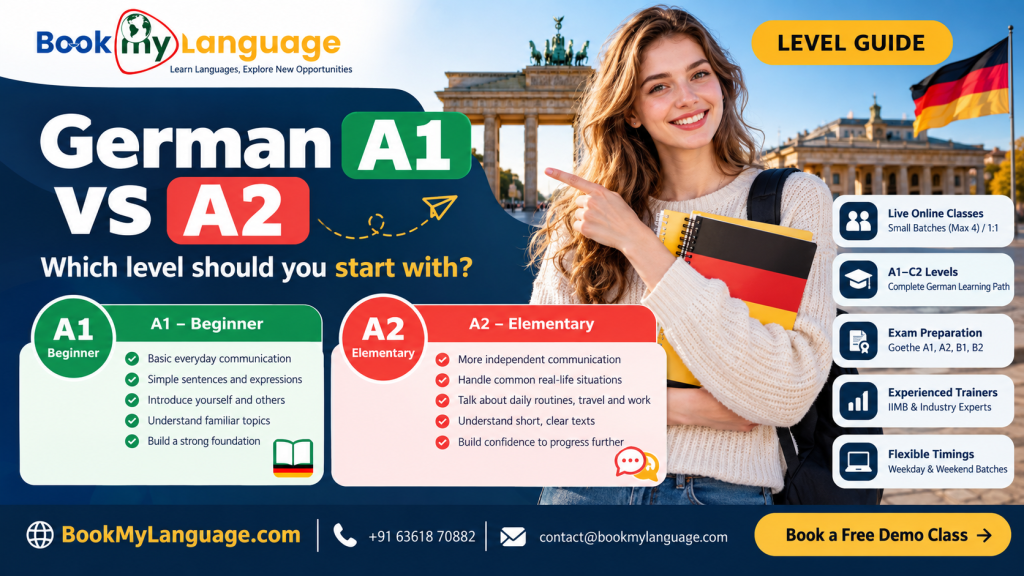
German A1 vs A2: Which Level Should You Start With?

Ready to start learning German? Choose your level, schedule and learning plan with BookMyLanguage. Book a Demo Class View Fees Details German A1 vs A2 is one of the most common comparisons for learners who are unsure where to begin. Both levels are part of the beginner stages of German, but they represent different degrees of independence. A1 focuses on building the first foundation, while A2 expects you to use that foundation in a wider range of everyday situations. If you have never studied German before, A1 is normally the correct starting point. If you already understand simple sentences, can introduce yourself comfortably and can handle familiar conversations without translating every word, A2 may be more appropriate. The difference between German A1 and A2 is therefore not one particular grammar chapter. It is the learner’s overall ability to understand, respond and communicate with increasing independence. Both levels belong to the Common European Framework of Reference for Languages (CEFR). The CEFR describes language ability through practical communication outcomes, and Goethe-Institut also uses the A1–C2 framework for German courses and examinations. This guide explains German A1 vs A2 through speaking, listening, reading, writing, grammar and practical communication so that you can choose a more appropriate starting level. If you are learning German for higher studies, check the German language requirements for universities in Germany before deciding whether A1, A2, B1, or a higher level is your real target.   German A1 vs A2: Quick Comparison Area A1 – Beginner Foundation A2 – Elementary Communication Starting point Suitable for complete beginners or learners with very limited German. Suitable for learners who already have an A1 foundation. Typical communication You rely on familiar expressions and need support. You can manage routine exchanges with greater independence. Speaking Introduce yourself, answer basic questions, order food and ask for repetition. Describe routines, previous experiences, plans, preferences and simple problems. Listening Understand key information in slow and clear speech about familiar topics. Follow the main point of short conversations, messages and announcements. Reading Understand forms, signs, menus, short messages and simple profiles. Understand short practical and personal texts containing greater detail. Writing Complete forms and write short messages, invitations and basic sentences. Write connected notes, descriptions, requests and simple explanations. Grammar Build the foundation of sentence structure, verbs, articles and cases. Use the existing foundation in more varied sentence structures. Independence Communication normally requires considerable support. You handle familiar everyday situations with fewer prompts. What Do You Learn in German A1? A1 is designed for learners who need German from the beginning. The main objective is to create a reliable foundation for future levels. Early lessons normally introduce pronunciation, greetings, introductions, numbers, dates, time and simple questions. Learners then gradually expand into everyday topics such as: Family and relationships Home and surroundings Daily routines Food and drinks Shopping Appointments Hobbies and free time Travel and transportation Basic health situations Simple requests and directions Grammar at A1 supports practical sentence building. Typical areas may include: Personal pronouns Present-tense verbs Common irregular verbs Definite and indefinite articles Basic nominative and accusative structures Possessive forms Question words Basic modal verbs Negation with nicht and kein Common separable verbs Basic prepositions German word order A1 learners should practise all four skills from the beginning. Memorising a dialogue is useful for initial practice, but genuine progress requires understanding what you are saying and learning how to adapt sentences to new situations. If you are completely new to German, our German A1 Classes Online provide a structured starting point. Who Should Start with German A1? Choose A1 if most of these statements describe you: You have never studied German before. You studied German previously but remember very little. You cannot yet introduce yourself without translating each sentence. German articles and word order are unfamiliar to you. You recognise individual German words but cannot follow a short conversation. You struggle to build simple sentences independently. You want a structured foundation before progressing to A2. You are preparing for an A1 examination but still need the complete language foundation. Starting from A1 is not a disadvantage. A strong foundation can prevent recurring errors from becoming harder to correct at B1 or B2. What Changes at German A2? A2 assumes that the learner already understands the main foundations taught at A1. Instead of beginning again with basic introductions and individual phrases, learners spend more time connecting ideas and communicating about ordinary situations. At A2, you may practise how to: Describe your work or studies Talk about a previous weekend or holiday Discuss daily routines in greater detail Explain a simple problem Make and change plans Compare options Talk about travel Describe health concerns Make appointments Explain preferences Write short personal or practical messages Grammar also develops further. Learners may work with past communication, sentence connectors, prepositions, dative structures, reflexive verbs, comparisons and more flexible sentence patterns. However, the most important change in the German A1 vs A2 comparison is not simply the number of grammar topics. A2 students are expected to use familiar German with greater independence. You can explore our German A2 Classes Online for the next stage after A1. Who Is Ready for German A2? Consider A2 when most of these statements are true: You can introduce yourself and ask another person simple follow-up questions. You can describe your everyday routine in German. You can talk briefly about something that happened previously. You can explain a simple future plan. You understand the main idea of slow conversations about familiar subjects. You can read short messages and understand their purpose. You can write a short German message without translating every sentence. You understand basic German sentence order and common grammatical patterns. If several of these tasks remain very difficult, repeating or strengthening A1 may be more useful than moving immediately into A2. German A1 vs A2: Speaking Differences Speaking is one of the clearest ways to understand the difference between the two levels. At A1, conversations are normally short and predictable. Learners may introduce themselves,

German A1 syllabus
Blog, Foreign Language

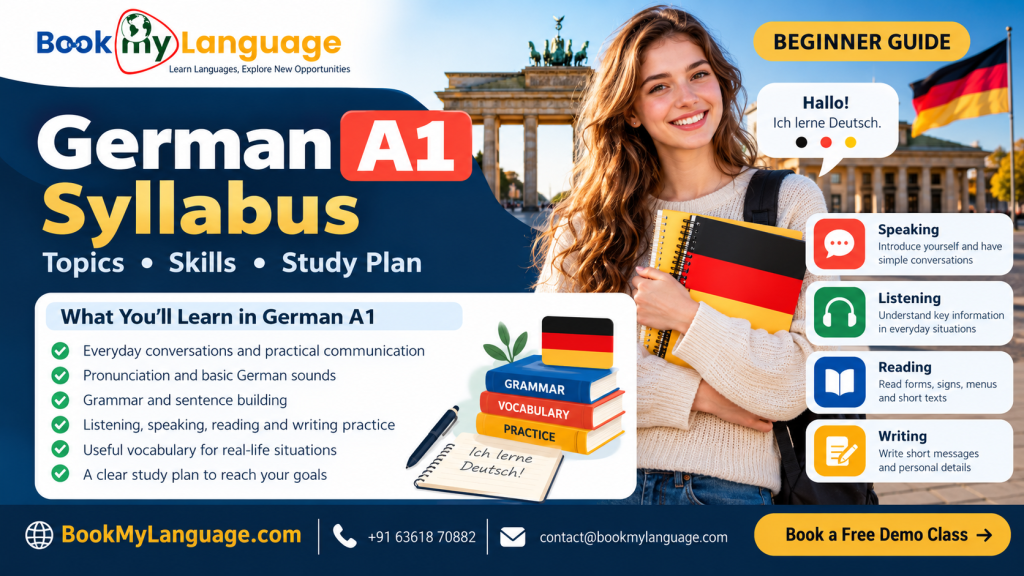
German A1 Syllabus: Topics, Skills and a Practical Study Plan

Ready to start learning German? Choose your level, schedule and learning plan with BookMyLanguage. Book a Demo Class View Fees Details A German A1 syllabus gives complete beginners a clear roadmap for building their first practical communication skills. A1 is not simply a list of grammar chapters. A well-designed beginner programme combines everyday vocabulary, pronunciation, sentence formation, listening, speaking, reading and writing so learners can gradually begin using German in real situations. If you are starting German for the first time, understanding the syllabus before joining a course can help you know what to expect. It also makes it easier to compare different institutes because textbooks and chapter order may vary even when the overall learning objective is similar. This guide explains the main topics, grammar areas, communication skills and study habits commonly found in a German A1 syllabus. It also includes a practical study-plan example and a checklist to help you decide whether you are ready to progress toward A2. What Does German A1 Mean? A1 is the first level of the Common European Framework of Reference for Languages, commonly known as the CEFR. The framework describes language ability through what learners can understand and communicate rather than simply by the number of lessons completed. At A1, learners begin working toward the ability to understand and use familiar expressions, introduce themselves, ask and answer simple personal questions, understand basic written information and communicate in very predictable everyday situations when the other person communicates clearly and supportively. A1 does not mean that you will understand normal fast German conversations after completing the course. It provides the foundation needed to continue learning more independently at A2 and later levels. The purpose of a German A1 syllabus is therefore to establish reliable beginner skills rather than rush students toward advanced grammar before the fundamentals are secure. Students preparing to study in Germany should also understand the German language requirements for university admission before deciding how far they need to progress. German A1 Syllabus: Core Communication Topics Most beginner courses organise vocabulary around real-life situations. The exact sequence can differ according to the textbook or trainer, but the core themes are usually similar. Greetings and saying goodbye Introducing yourself and other people Names, countries, nationalities and languages Personal information and contact details Numbers, dates and time Days of the week and appointments Family and relationships Home, rooms and everyday objects Daily routines Work and study Hobbies and free-time activities Food and drinks Shopping, quantities and prices Restaurants and ordering Travel and transportation Directions and places in a city Hotels and basic travel needs Simple health situations Weather and seasons Basic invitations and arrangements Forms, notices, menus and timetables Short personal messages and emails A useful course does not teach these themes only as vocabulary lists. The same topic should return through multiple skills. For example, an appointment lesson might involve listening to a short conversation, identifying a date and time, asking whether a particular time is available, reading an appointment confirmation and writing a short reply. Grammar in a German A1 Syllabus German grammar can seem difficult when it is presented as a large collection of rules. At A1, grammar should instead help learners perform basic communication tasks. The exact order varies, but a practical beginner course commonly introduces: Personal pronouns Present-tense verb conjugation The verbs sein and haben Common regular and irregular verbs Definite articles: der, die, das Indefinite articles: ein, eine Plural forms The idea of grammatical gender Basic nominative structures Common accusative structures Frequently used dative expressions Possessive forms such as mein, dein, sein and ihr Question words Yes/no questions Negation using nicht and kein Modal verbs such as können, müssen and wollen Separable verbs Common prepositions Time expressions Basic German word order Simple sentence connectors Instead of memorising an isolated grammar table, learners should practise structures in complete sentences. For example: Ich möchte einen Termin am Montag. Once the sentence is understood, change the day, time, purpose or person. This develops the ability to produce German rather than simply recognise a rule. Vocabulary Development at A1 Vocabulary is easier to remember when it is learned in context. For nouns, learn the article together with the word: der Tisch die Tasche das Buch For verbs, learn a short sentence showing how the verb is used. For useful expressions, try learning them as complete chunks rather than separate words. A practical German A1 syllabus should gradually build vocabulary around people, places, actions, time, food, transportation, shopping, home, work and everyday communication. The goal is not to memorise thousands of isolated words. Learners need enough active vocabulary to communicate about common beginner topics. German A1 Pronunciation Pronunciation deserves attention from the beginning because early habits can become difficult to change later. A1 learners may practise: German alphabet and spelling Long and short vowels Umlauts ä, ö and ü The German ch sounds The pronunciation of r Differences between s, z and sch Word stress Sentence rhythm Basic intonation in statements and questions Clear communication is more important than trying to imitate a native accent immediately. Recording a short self-introduction and listening back to it can be a useful beginner exercise. Compare your pronunciation with the model audio and repeat difficult phrases slowly before increasing speed. Four Skills Covered in the German A1 Syllabus Skill Typical A1 Practice Practical Goal Listening Introductions, times, prices, announcements and everyday requests Identify important information in slow, clear speech Speaking Self-introduction, simple questions, shopping, ordering and asking for repetition Maintain a short exchange using familiar language Reading Forms, signs, menus, messages, timetables and short profiles Locate important information such as names, dates, places and actions Writing Personal details, short messages, simple invitations and replies Communicate a basic need, plan or piece of information clearly Listening Skills at German A1 Listening can initially feel difficult because spoken language does not provide the same time for analysis as written German. Beginner listening tasks should help students recognise essential information rather than expect them to understand every word. Learners

Foreign Language

Advantages to Learn Foreign Language

In an increasingly globalized world, the ability to communicate in more than one language is more valuable than ever. Learning a foreign language is not just a practical skill but a gateway to a myriad of advantages that can enhance your personal, professional, and cognitive development. Here’s a closer look at the compelling benefits of mastering a new language. 1. Boosted Cognitive Abilities Learning a foreign language is a mental workout that strengthens your brain. It enhances cognitive functions such as memory, problem-solving skills, and multitasking. Research has shown that bilingual individuals tend to have better executive function, which includes planning, decision-making, and the ability to switch between tasks. This mental exercise keeps your brain sharp and can even delay the onset of age-related cognitive decline. 2. Enhanced Career Prospects In today’s competitive job market, multilingualism is a standout asset. Many employers actively seek individuals who can communicate with clients, partners, and colleagues from diverse backgrounds. Being proficient in another language can make you a more attractive candidate for job positions, lead to promotions, and increase your earning potential. Language skills can open doors to international opportunities and give you a competitive edge in various fields. 3. Richer Travel Experiences Traveling becomes infinitely more rewarding when you can speak the local language. It allows you to navigate new places with ease, engage more deeply with local cultures, and form genuine connections with residents. Whether you’re ordering food, asking for directions, or exploring off-the-beaten-path destinations, being able to communicate in the local language enhances your travel experience and helps you get more out of your adventures. 4. Deeper Cultural Understanding Language and culture are deeply intertwined. By learning a foreign language, you gain insight into the customs, traditions, and worldviews of other cultures. This cultural awareness fosters empathy and appreciation for diversity, making you more open-minded and culturally literate. It also allows you to enjoy literature, music, films, and art in their original forms, providing a richer cultural experience. 5. Improved Communication Skills Mastering a foreign language improves your overall communication abilities. It enhances your understanding of language structures, expands your vocabulary, and refines your listening skills. These improvements translate into better communication in your native language, as you become more adept at expressing ideas clearly and understanding others more effectively. 6. Increased Problem-Solving Skills The process of learning and using a foreign language involves navigating complex grammatical rules and cultural contexts. This mental challenge enhances your problem-solving skills and creativity. You learn to approach tasks from different perspectives and find innovative solutions, which is a valuable skill in both personal and professional settings. 7. Stronger Memory Studies have shown that bilingual individuals tend to have better memory skills. Learning and using a new language exercises your brain’s ability to retain and recall information. This improved memory can benefit various aspects of your life, from remembering names and dates to keeping track of daily tasks and responsibilities. 8. Personal Growth and Confidence Acquiring a new language is a significant personal achievement that boosts your confidence and self-esteem. Overcoming the challenges of language learning fosters a sense of accomplishment and resilience. This newfound confidence can translate into other areas of your life, encouraging you to take on new challenges and pursue personal growth. 9. Broadened Social Network Being able to communicate in another language opens up opportunities to connect with a wider range of people. It allows you to build relationships with individuals from different cultural backgrounds, both personally and professionally. These connections can lead to new friendships, collaborations, and networking opportunities that enrich your social and professional life. 10. Greater Adaptability In a rapidly changing world, the ability to adapt is crucial. Learning a foreign language equips you with the skills to navigate different cultural and linguistic environments. This adaptability is an asset in various situations, from working in diverse teams to interacting with people from different backgrounds. Conclusion The advantages of learning a foreign language extend far beyond the ability to converse in another tongue. It’s an investment in your cognitive development, career advancement, and personal growth. From enhancing your memory and problem-solving skills to enriching your travel experiences and cultural understanding, the benefits are both profound and far-reaching. So whether you’re motivated by professional goals, personal interests, or the desire to connect with others, embarking on the journey of language learning is a choice that can transform your life in extraordinary ways.

Foreign Language

Why to Learn Foreign language

In a world that’s becoming increasingly interconnected, learning a foreign language is no longer just a niche skill—it’s a gateway to countless opportunities and enriching experiences. From personal growth to professional advancement, the benefits of mastering a new language extend far beyond mere communication. Here’s why diving into the realm of foreign languages is a decision you won’t regret. 1. Cognitive Boost Learning a new language is like a workout for your brain. Studies have shown that bilingualism enhances cognitive abilities, including improved memory, better problem-solving skills, and greater multitasking efficiency. Engaging with a foreign language strengthens neural connections, leading to sharper thinking and increased mental agility. 2. Cultural Appreciation Understanding a language opens the door to its culture. Whether it’s savoring authentic cuisine, enjoying literature in its original form, or appreciating the nuances of traditional music and art, language learning deepens your connection to diverse cultures. It fosters empathy and broadens your worldview, helping you appreciate the richness of human diversity. 3. Career Advancement In the global job market, multilingualism is a highly sought-after skill. Employers value employees who can communicate with international clients, navigate global markets, and contribute to cross-cultural teams. Being fluent in another language can set you apart from other candidates, opening doors to new job opportunities, promotions, and higher salaries. 4. Travel Enrichment Traveling becomes a far more immersive experience when you can converse with locals in their native tongue. It enhances your ability to navigate new environments, understand cultural nuances, and form genuine connections with people you meet. This leads to more authentic travel experiences and deeper appreciation of the places you visit. 5. Enhanced Communication Skills Learning a foreign language often improves your overall communication abilities. It helps you understand the structure of language better, leading to more effective verbal and written communication in your native language as well. The skills you develop in listening, interpreting, and expressing ideas translate into better communication across the board. 6. Personal Fulfillment Mastering a new language is a rewarding achievement that brings a sense of personal satisfaction. It challenges you, helps you overcome obstacles, and provides a sense of accomplishment. Plus, it opens up a whole new realm of literature, media, and conversations that enrich your personal life. 7. Building Relationships Languages are bridges between people. Being able to speak someone’s language fosters trust and strengthens relationships. It allows you to connect on a deeper level, whether in personal friendships or professional networks, leading to more meaningful interactions and connections. 8. Enhanced Problem-Solving Skills The process of learning and using a foreign language requires you to think creatively and adaptively. It involves navigating different grammatical structures and cultural contexts, which enhances your problem-solving skills and ability to think on your feet. 9. Future-Proofing Your Skills In an era where automation and artificial intelligence are transforming the job landscape, human-centric skills like language proficiency remain invaluable. Multilingualism provides a competitive edge that’s less likely to be replaced by technology, ensuring your skills stay relevant and adaptable. 10. Expanding Your Horizons Finally, learning a foreign language expands your horizons in ways you might not have imagined. It opens up new intellectual and cultural experiences, offers new perspectives on global issues, and encourages lifelong learning and curiosity. In Conclusion The decision to learn a foreign language is an investment in your future—one that enriches your life on multiple levels. From cognitive and professional benefits to personal fulfillment and cultural appreciation, the rewards of multilingualism are vast and varied. So why wait? Start learning today and unlock a world of possibilities. The journey may be challenging, but the destinations are boundless.

Scroll to Top