
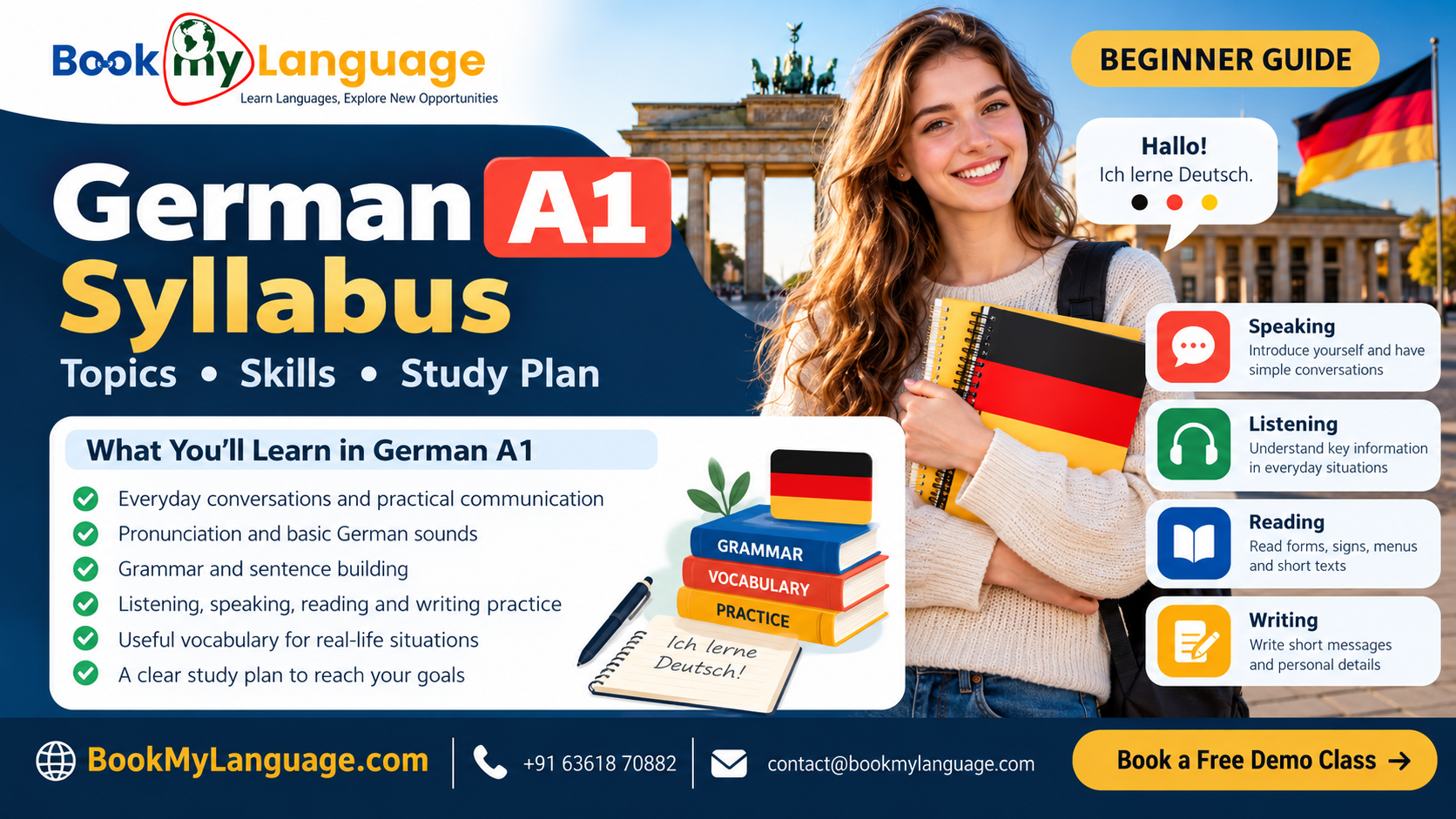
A German A1 syllabus gives complete beginners a clear roadmap for building their first practical communication skills. A1 is not simply a list of grammar chapters. A well-designed beginner programme combines everyday vocabulary, pronunciation, sentence formation, listening, speaking, reading and writing so learners can gradually begin using German in real situations.
If you are starting German for the first time, understanding the syllabus before joining a course can help you know what to expect. It also makes it easier to compare different institutes because textbooks and chapter order may vary even when the overall learning objective is similar.
This guide explains the main topics, grammar areas, communication skills and study habits commonly found in a German A1 syllabus. It also includes a practical study-plan example and a checklist to help you decide whether you are ready to progress toward A2.
What Does German A1 Mean?
A1 is the first level of the Common European Framework of Reference for Languages, commonly known as the CEFR. The framework describes language ability through what learners can understand and communicate rather than simply by the number of lessons completed.
At A1, learners begin working toward the ability to understand and use familiar expressions, introduce themselves, ask and answer simple personal questions, understand basic written information and communicate in very predictable everyday situations when the other person communicates clearly and supportively.
A1 does not mean that you will understand normal fast German conversations after completing the course. It provides the foundation needed to continue learning more independently at A2 and later levels.
The purpose of a German A1 syllabus is therefore to establish reliable beginner skills rather than rush students toward advanced grammar before the fundamentals are secure.
German A1 Syllabus: Core Communication Topics
Most beginner courses organise vocabulary around real-life situations. The exact sequence can differ according to the textbook or trainer, but the core themes are usually similar.
- Greetings and saying goodbye
- Introducing yourself and other people
- Names, countries, nationalities and languages
- Personal information and contact details
- Numbers, dates and time
- Days of the week and appointments
- Family and relationships
- Home, rooms and everyday objects
- Daily routines
- Work and study
- Hobbies and free-time activities
- Food and drinks
- Shopping, quantities and prices
- Restaurants and ordering
- Travel and transportation
- Directions and places in a city
- Hotels and basic travel needs
- Simple health situations
- Weather and seasons
- Basic invitations and arrangements
- Forms, notices, menus and timetables
- Short personal messages and emails
A useful course does not teach these themes only as vocabulary lists. The same topic should return through multiple skills.
For example, an appointment lesson might involve listening to a short conversation, identifying a date and time, asking whether a particular time is available, reading an appointment confirmation and writing a short reply.
Grammar in a German A1 Syllabus
German grammar can seem difficult when it is presented as a large collection of rules. At A1, grammar should instead help learners perform basic communication tasks.
The exact order varies, but a practical beginner course commonly introduces:
- Personal pronouns
- Present-tense verb conjugation
- The verbs sein and haben
- Common regular and irregular verbs
- Definite articles: der, die, das
- Indefinite articles: ein, eine
- Plural forms
- The idea of grammatical gender
- Basic nominative structures
- Common accusative structures
- Frequently used dative expressions
- Possessive forms such as mein, dein, sein and ihr
- Question words
- Yes/no questions
- Negation using nicht and kein
- Modal verbs such as können, müssen and wollen
- Separable verbs
- Common prepositions
- Time expressions
- Basic German word order
- Simple sentence connectors
Instead of memorising an isolated grammar table, learners should practise structures in complete sentences.
For example:
Ich möchte einen Termin am Montag.
Once the sentence is understood, change the day, time, purpose or person. This develops the ability to produce German rather than simply recognise a rule.
Vocabulary Development at A1
Vocabulary is easier to remember when it is learned in context.
For nouns, learn the article together with the word:
- der Tisch
- die Tasche
- das Buch
For verbs, learn a short sentence showing how the verb is used. For useful expressions, try learning them as complete chunks rather than separate words.
A practical German A1 syllabus should gradually build vocabulary around people, places, actions, time, food, transportation, shopping, home, work and everyday communication.
The goal is not to memorise thousands of isolated words. Learners need enough active vocabulary to communicate about common beginner topics.
German A1 Pronunciation
Pronunciation deserves attention from the beginning because early habits can become difficult to change later.
A1 learners may practise:
- German alphabet and spelling
- Long and short vowels
- Umlauts ä, ö and ü
- The German ch sounds
- The pronunciation of r
- Differences between s, z and sch
- Word stress
- Sentence rhythm
- Basic intonation in statements and questions
Clear communication is more important than trying to imitate a native accent immediately.
Recording a short self-introduction and listening back to it can be a useful beginner exercise. Compare your pronunciation with the model audio and repeat difficult phrases slowly before increasing speed.
Four Skills Covered in the German A1 Syllabus
| Skill | Typical A1 Practice | Practical Goal |
|---|---|---|
| Listening | Introductions, times, prices, announcements and everyday requests | Identify important information in slow, clear speech |
| Speaking | Self-introduction, simple questions, shopping, ordering and asking for repetition | Maintain a short exchange using familiar language |
| Reading | Forms, signs, menus, messages, timetables and short profiles | Locate important information such as names, dates, places and actions |
| Writing | Personal details, short messages, simple invitations and replies | Communicate a basic need, plan or piece of information clearly |
Listening Skills at German A1
Listening can initially feel difficult because spoken language does not provide the same time for analysis as written German.
Beginner listening tasks should help students recognise essential information rather than expect them to understand every word.
Learners may practise:
- Names and spelling
- Telephone numbers
- Prices
- Dates and times
- Locations
- Simple instructions
- Short dialogues
- Basic announcements
A useful strategy is to listen first for the overall situation, then listen again for specific details.
Speaking Skills at A1
Speaking should begin early in a German A1 syllabus. Learners do not need to wait until they understand every grammar rule before attempting to communicate.
Typical A1 speaking tasks include:
- Introducing yourself
- Talking briefly about family
- Saying where you live
- Explaining what you do
- Talking about hobbies
- Ordering food or drinks
- Asking about prices
- Making simple arrangements
- Asking for directions
- Requesting repetition or clarification
Early conversations will be short and may contain errors. The objective is gradually to improve accuracy while also developing confidence.
Reading Skills at A1
A1 reading normally focuses on short practical texts rather than long articles.
Learners may work with:
- Signs
- Advertisements
- Menus
- Schedules
- Forms
- Short emails
- Messages
- Simple online information
- Personal profiles
The learner should gradually become able to locate useful information without translating every individual word.
Writing Skills at A1
Writing reinforces vocabulary and grammar because it forces learners to organise sentences more carefully.
Typical beginner tasks may include:
- Completing personal details
- Writing a short introduction
- Sending a simple message
- Accepting or declining an invitation
- Writing an appointment request
- Describing a basic daily routine
At A1, clarity is more important than producing sophisticated writing.
A Sample Eight-Week German A1 Study Plan
This is an example of how beginner material can be organised. It is not a compulsory CEFR timetable, and an institute may structure its course differently.
- Week 1: pronunciation, greetings, spelling, introductions and basic sentence formation.
- Week 2: numbers, dates, time, countries, languages and present-tense verbs.
- Week 3: family, personal information, articles and possessive forms.
- Week 4: home, daily routine, question formation and German word order.
- Week 5: food, drinks, shopping, quantities and common accusative structures.
- Week 6: appointments, hobbies, modal verbs and listening practice.
- Week 7: travel, transportation, directions and practical role plays.
- Week 8: health, messages, revision and mixed four-skill practice.
The important point is not completing every topic exactly within eight weeks. Different courses have different numbers of teaching hours.
BookMyLanguage’s regular A1 programme currently consists of approximately 60 training hours.
How to Study Between German A1 Classes
Classroom instruction becomes more effective when learners practise regularly between lessons.
A simple daily routine can include three activities:
- Review older vocabulary for 10–15 minutes.
- Listen to a short German dialogue and repeat key sentences aloud.
- Produce something yourself: a short message, several sentences or a one-minute voice recording.
Active production is important. Silently reading a vocabulary list can create familiarity, but speaking or writing forces you to retrieve the language yourself.
Common Beginner Mistakes
Several study habits can slow down A1 progress.
- Trying to translate every German sentence word for word
- Learning nouns without articles
- Studying grammar without creating example sentences
- Avoiding speaking because of fear of mistakes
- Ignoring pronunciation
- Memorising dialogues without understanding how to change them
- Studying intensively once a week instead of practising regularly
- Moving into A2 before the beginner foundation is sufficiently stable
The objective is not perfect German at A1. Mistakes are normal. What matters is that learners steadily become able to understand and produce more useful communication.
How Do You Know You Have Completed the German A1 Syllabus?
Finishing a textbook chapter does not automatically mean that the level is complete.
You are developing a good A1 foundation when you can perform tasks such as:
- Introduce yourself without reading from a script
- Spell your name and provide contact details
- Ask and answer simple personal questions
- Understand the main point of a slow familiar conversation
- Read a short practical message
- Complete a basic form
- Ask for clarification
- Write a short message about a real plan
- Use basic vocabulary in complete sentences
- Participate in short everyday exchanges
You will still make grammatical and pronunciation errors. A1 is a beginner foundation, not complete fluency.
German A1 Syllabus vs German A2
A1 focuses on establishing basic communication. A2 assumes that foundation already exists and asks the learner to communicate more independently in routine situations.
If you are unsure whether you should begin with A1 or move directly into A2, read our detailed:
German A1 vs A2: Which Level Should You Start With?
The comparison includes a practical self-check covering speaking, listening, reading and writing.
German A1 Syllabus for Goethe Exam Preparation
A language syllabus and an examination format are related but should not be treated as the same thing.
First develop the general language ability expected at A1. Then add examination-specific practice such as understanding task instructions, managing time, listening for requested details and practising the expected speaking and writing formats.
Students preparing for the Goethe A1 examination can read our dedicated:
German A1 Exam Preparation Guide
For official examination requirements and current practice materials, learners should also consult Goethe-Institut directly.
A BookMyLanguage course completion certificate is separate from an official Goethe examination certificate.
How BookMyLanguage Covers German A1
BookMyLanguage offers live German classes from A1 through C2, with small-group and one-to-one options.
Our regular A1 programme is designed to combine grammar and vocabulary with speaking, listening, reading and writing practice.
You can explore:
German A1 Classes Online
German Classes Online – A1 to C2
German Course Fees
German A1 Exam Preparation
Best Online German Classes in India
If you want to understand the teaching format before enrolling, you can book a free demo class.
Frequently Asked Questions About the German A1 Syllabus
Is German A1 suitable for complete beginners?
Yes. A1 is normally the starting level for someone with no previous German knowledge.
What topics are covered in German A1?
A1 usually covers personal information, family, home, work, study, hobbies, food, shopping, appointments, travel, transportation, everyday needs and other basic communication situations.
Does German A1 include grammar?
Yes. Beginner grammar typically includes basic sentence order, present-tense verbs, articles, question formation, negation, common cases, possessive forms, modal verbs and frequently used prepositions.
Does a German A1 syllabus include speaking?
Yes. Speaking should be practised from the beginning through introductions, simple questions, role plays and short everyday exchanges.
How long is BookMyLanguage German A1?
The regular BookMyLanguage A1 programme currently consists of approximately 60 training hours.
Can I study German A1 online?
Yes. Live online A1 training can cover the same core language skills as an offline programme when learners have regular trainer interaction, speaking opportunities and appropriate practice.
What comes after German A1?
After developing the A1 foundation, learners normally progress to A2.
Do I need a Goethe certificate before studying A2?
Not necessarily. Completing a course level and taking an external examination are separate processes. A training provider may assess your existing German before placing you into A2.
Final Thoughts
A strong German A1 syllabus should do more than introduce vocabulary and grammar rules. It should help a complete beginner begin using German through listening, speaking, reading and writing.
Use the syllabus as a roadmap rather than a checklist of chapters. Different textbooks and trainers may organise material differently, but the overall goal remains the same: build a reliable beginner foundation that allows you to communicate in simple everyday situations and continue toward A2 with confidence.
Study regularly, practise speaking from the beginning, review earlier vocabulary and focus on what you can actually do with German rather than how many pages you have completed.