
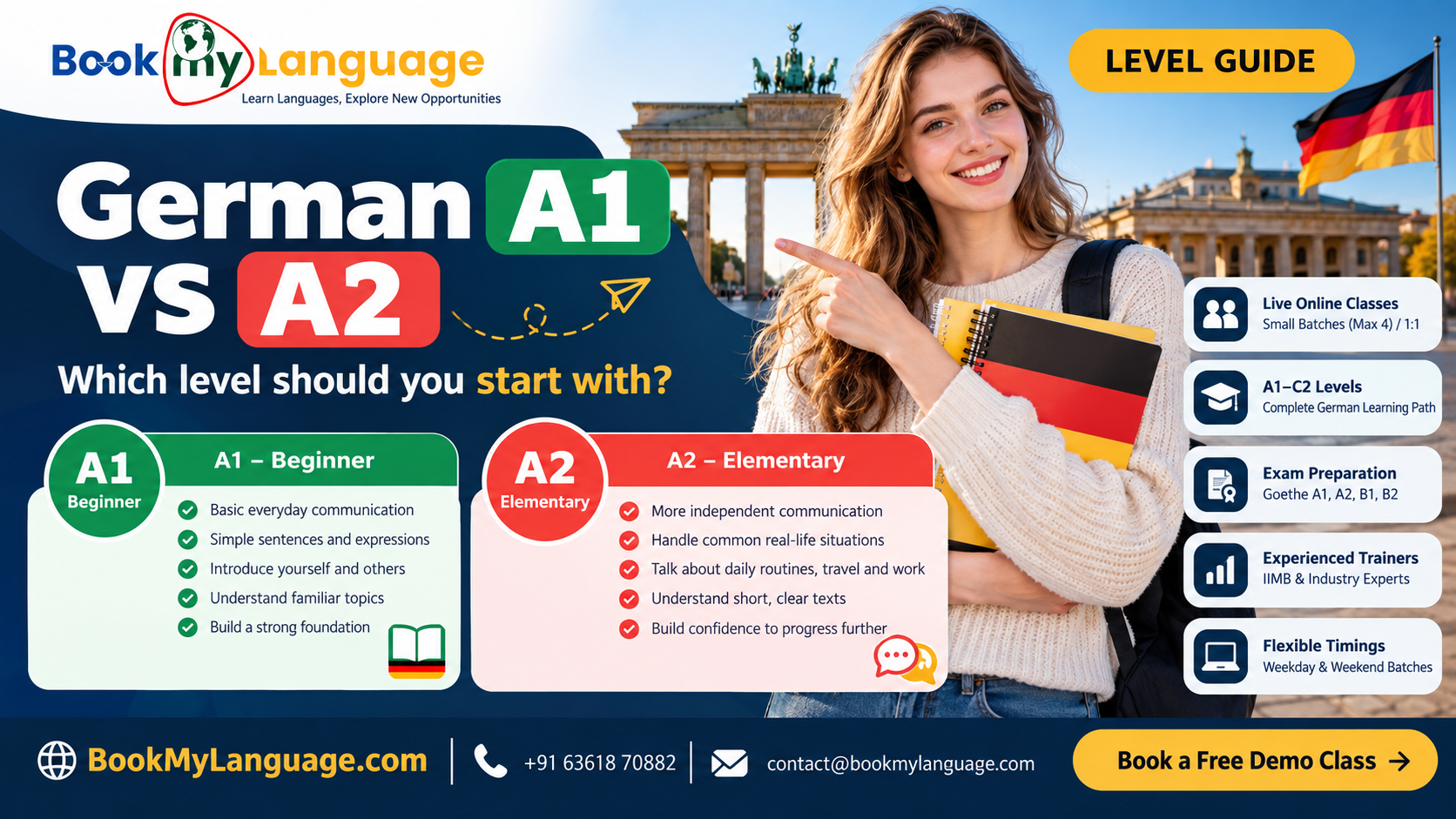
German A1 vs A2 is one of the most common comparisons for learners who are unsure where to begin. Both levels are part of the beginner stages of German, but they represent different degrees of independence. A1 focuses on building the first foundation, while A2 expects you to use that foundation in a wider range of everyday situations.
If you have never studied German before, A1 is normally the correct starting point. If you already understand simple sentences, can introduce yourself comfortably and can handle familiar conversations without translating every word, A2 may be more appropriate.
The difference between German A1 and A2 is therefore not one particular grammar chapter. It is the learner’s overall ability to understand, respond and communicate with increasing independence.
Both levels belong to the Common European Framework of Reference for Languages (CEFR). The CEFR describes language ability through practical communication outcomes, and Goethe-Institut also uses the A1–C2 framework for German courses and examinations.
This guide explains German A1 vs A2 through speaking, listening, reading, writing, grammar and practical communication so that you can choose a more appropriate starting level.
German A1 vs A2: Quick Comparison
| Area | A1 – Beginner Foundation | A2 – Elementary Communication |
|---|---|---|
| Starting point | Suitable for complete beginners or learners with very limited German. | Suitable for learners who already have an A1 foundation. |
| Typical communication | You rely on familiar expressions and need support. | You can manage routine exchanges with greater independence. |
| Speaking | Introduce yourself, answer basic questions, order food and ask for repetition. | Describe routines, previous experiences, plans, preferences and simple problems. |
| Listening | Understand key information in slow and clear speech about familiar topics. | Follow the main point of short conversations, messages and announcements. |
| Reading | Understand forms, signs, menus, short messages and simple profiles. | Understand short practical and personal texts containing greater detail. |
| Writing | Complete forms and write short messages, invitations and basic sentences. | Write connected notes, descriptions, requests and simple explanations. |
| Grammar | Build the foundation of sentence structure, verbs, articles and cases. | Use the existing foundation in more varied sentence structures. |
| Independence | Communication normally requires considerable support. | You handle familiar everyday situations with fewer prompts. |
What Do You Learn in German A1?
A1 is designed for learners who need German from the beginning. The main objective is to create a reliable foundation for future levels.
Early lessons normally introduce pronunciation, greetings, introductions, numbers, dates, time and simple questions. Learners then gradually expand into everyday topics such as:
- Family and relationships
- Home and surroundings
- Daily routines
- Food and drinks
- Shopping
- Appointments
- Hobbies and free time
- Travel and transportation
- Basic health situations
- Simple requests and directions
Grammar at A1 supports practical sentence building. Typical areas may include:
- Personal pronouns
- Present-tense verbs
- Common irregular verbs
- Definite and indefinite articles
- Basic nominative and accusative structures
- Possessive forms
- Question words
- Basic modal verbs
- Negation with nicht and kein
- Common separable verbs
- Basic prepositions
- German word order
A1 learners should practise all four skills from the beginning. Memorising a dialogue is useful for initial practice, but genuine progress requires understanding what you are saying and learning how to adapt sentences to new situations.
If you are completely new to German, our German A1 Classes Online provide a structured starting point.
Who Should Start with German A1?
Choose A1 if most of these statements describe you:
- You have never studied German before.
- You studied German previously but remember very little.
- You cannot yet introduce yourself without translating each sentence.
- German articles and word order are unfamiliar to you.
- You recognise individual German words but cannot follow a short conversation.
- You struggle to build simple sentences independently.
- You want a structured foundation before progressing to A2.
- You are preparing for an A1 examination but still need the complete language foundation.
Starting from A1 is not a disadvantage. A strong foundation can prevent recurring errors from becoming harder to correct at B1 or B2.
What Changes at German A2?
A2 assumes that the learner already understands the main foundations taught at A1.
Instead of beginning again with basic introductions and individual phrases, learners spend more time connecting ideas and communicating about ordinary situations.
At A2, you may practise how to:
- Describe your work or studies
- Talk about a previous weekend or holiday
- Discuss daily routines in greater detail
- Explain a simple problem
- Make and change plans
- Compare options
- Talk about travel
- Describe health concerns
- Make appointments
- Explain preferences
- Write short personal or practical messages
Grammar also develops further. Learners may work with past communication, sentence connectors, prepositions, dative structures, reflexive verbs, comparisons and more flexible sentence patterns.
However, the most important change in the German A1 vs A2 comparison is not simply the number of grammar topics. A2 students are expected to use familiar German with greater independence.
You can explore our German A2 Classes Online for the next stage after A1.
Who Is Ready for German A2?
Consider A2 when most of these statements are true:
- You can introduce yourself and ask another person simple follow-up questions.
- You can describe your everyday routine in German.
- You can talk briefly about something that happened previously.
- You can explain a simple future plan.
- You understand the main idea of slow conversations about familiar subjects.
- You can read short messages and understand their purpose.
- You can write a short German message without translating every sentence.
- You understand basic German sentence order and common grammatical patterns.
If several of these tasks remain very difficult, repeating or strengthening A1 may be more useful than moving immediately into A2.
German A1 vs A2: Speaking Differences
Speaking is one of the clearest ways to understand the difference between the two levels.
At A1, conversations are normally short and predictable. Learners may introduce themselves, talk about family, order something in a café or answer simple questions.
At A2, the learner begins extending those exchanges. Instead of giving only a short answer, the learner may add details, explain a reason or ask relevant follow-up questions.
For example:
A1: “I live in Bengaluru. I work in IT. I learn German.”
A2: A learner may explain where they work, what they normally do during the day, why they are studying German and what they plan to do later.
The language may still contain mistakes, but communication becomes less dependent on memorised responses.
German A1 vs A2: Listening Differences
At A1, students normally rely on slow, clearly pronounced German and familiar vocabulary.
The objective is often to catch important information such as a name, number, time, place or simple instruction.
At A2, listening expands into slightly longer conversations and announcements. The learner may not understand every individual word, but should increasingly identify the main message and important details.
This is an important stage because real conversations rarely follow the exact dialogue presented in a textbook.
German A1 vs A2: Reading and Writing
Reading at A1 usually begins with short, practical texts such as signs, menus, forms, simple advertisements and personal messages.
At A2, learners read longer practical texts and identify more detailed information.
Writing develops in the same direction.
An A1 learner may complete personal information or write a short invitation. An A2 learner should begin connecting sentences into short descriptions, requests or explanations.
Writing is particularly useful because it reveals grammatical and vocabulary gaps that may be less obvious during a fast conversation.
A Simple German A1 vs A2 Self-Check
Try the following tasks without using a dictionary or translation application. This is only an informal self-check, not an official placement examination.
- Introduce yourself and explain where you live, what you do and why you are learning German.
- Ask another person three questions about their daily routine.
- Describe what you did yesterday using simple sentences.
- Explain what you plan to do tomorrow.
- Explain that you cannot attend an appointment and suggest another time.
- Read a short German message and identify the date, place, purpose and requested action.
- Write six to eight sentences combining information about yesterday, today and tomorrow.
If you can complete only the first one or two tasks with significant support, A1 may be the safer starting point.
If you can complete most of the tasks but still make regular grammar mistakes, A2 may be appropriate.
If all of these tasks feel straightforward, ask a trainer whether your current skills may already be approaching B1 rather than automatically enrolling in A2.
Why a Placement Conversation Matters
Self-assessment is useful, but it can sometimes be misleading.
A learner who has spent months using a vocabulary application may recognise hundreds of German words but struggle to understand a live conversation.
Another learner may have lived in a German-speaking environment and developed conversational confidence while still having significant gaps in grammar and writing.
A useful placement discussion should therefore consider several areas:
- Speaking
- Listening
- Reading
- Writing
- Grammar
- Vocabulary
Your objective also matters. Someone studying German for daily communication may have different immediate priorities from someone preparing for an external examination.
German A1 vs A2 for Exam Preparation
Choosing between German A1 vs A2 should be based on your actual language ability rather than the name of the examination you hope to take.
A course level and an examination registration are separate matters.
For examination preparation, first make sure that your general German is appropriate for the target level. After that, practise examination-specific tasks such as:
- Understanding task instructions
- Listening for specific information
- Reading efficiently
- Writing according to the required task
- Speaking within the examination format
- Managing time
- Using model papers appropriately
Avoid relying entirely on memorised answers. Examination questions can vary, and genuine language ability is more useful than memorising one expected response.
If you are working toward the beginner examination, read our detailed German A1 Exam Preparation Guide.
Official exam registration, assessment, results and official Goethe certificates are handled independently by Goethe-Institut and authorised examination centres.
Should You Skip A1 and Join A2?
Skipping A1 can make sense when you already possess the required foundation.
For example, you may have previously studied German at school, completed an A1 course elsewhere or developed basic German through substantial independent study.
However, recognising basic words is not enough by itself.
Before joining A2, you should ideally be comfortable with basic communication, essential sentence structure and the foundational vocabulary normally expected after A1.
Skipping too far ahead can create frustration because the trainer may assume that you already understand concepts that the class does not have time to reteach.
Should You Repeat A1 Before Starting A2?
Repeating an entire level is not always necessary either.
If your German foundation is generally strong but you have a few weaknesses, targeted revision may be more useful than restarting from the first lesson.
A trainer can help identify whether you need:
- A complete A1 restart
- Short revision before entering A2
- A normal A2 course
- A higher-level placement discussion
The objective is not to spend more time than necessary at a lower level, but also not to move forward with significant gaps.
How BookMyLanguage Can Support Your Next Step
BookMyLanguage provides live German classes from A1 through C2, including small-group and one-to-one learning options.
You can explore our complete German Classes Online A1–C2 pathway, review the German A1 course, or continue with the German A2 course.
You can also review our German Course Fees before choosing your learning format.
If you are comparing different institutes and learning formats, our Best Online German Classes in India guide explains what to compare before enrolling.
If you are still uncertain after reading this German A1 vs A2 guide, book a free demo class and discuss your existing German knowledge and learning objective before choosing a batch.
The right starting level should challenge you without turning every sentence into a translation exercise. Build a solid foundation, practise consistently and move to the next level when you can use the skills of the previous stage with reasonable confidence.
Frequently Asked Questions About German A1 vs A2
Is German A2 much harder than A1?
A2 is more demanding because learners are expected to communicate in a wider range of situations and rely less on memorised phrases. It builds directly on the foundation developed at A1.
Can a complete beginner start directly with A2?
Normally, no. A2 assumes that the learner already possesses basic A1 communication, grammar and vocabulary. Complete beginners are generally better served by starting with A1.
Can I move to A2 if my A1 grammar is weak?
It depends on the extent of the gaps. Minor weaknesses can often be revised during the transition, but significant problems with sentence formation, articles, verbs and basic communication may make A2 unnecessarily difficult.
What is the main difference between German A1 and A2?
The main difference is independence. A1 learners communicate through simple familiar structures with greater support, while A2 learners handle a wider range of routine situations and connect ideas with more independence.
Do A1 and A2 both include speaking?
Yes. Speaking should begin from A1 and become progressively more independent at A2.
Do I need an exam certificate before joining A2?
Not necessarily. Course placement and official examination certification are separate matters. A training provider may assess your existing German ability before allowing you to enter A2.